
Space Miscellaneous Space Stuff

worked4dhs

Active member
Joined
May 23, 2026
Messages
73
Reaction score
181
Thread for factoids and news items that don't warrant their own thread.

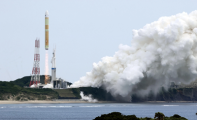
Japan successfully launches H3 rocket
Japan’s H3 rocket returned to flight Friday with the debut of a new low-cost variant, a badly needed success for the country’s new flagship rocket that has struggled with mission failures while facing an increasingly competitive space industry.

The H3 rocket took off from the Tanegashima Space Center on a southwestern Japanese island Friday morning and its second stage successfully reached a targeted orbit, the Japan Aerospace Exploration Agency said during its livestreaming.

Six small satellites developed by universities and other organizations carried by the vehicle also were believed to be successfully separated, JAXA said.


well done Japan
H3.png
 
Last edited by a moderator:

Just 10 months ago, NASA asked three companies if they could do something nobody had done before. Could they build and launch a satellite to save a $500 million astronomy mission at risk of crashing back to Earth? What’s more, could they do it in less than a year on a tight budget?

Katalyst Space Technologies, a startup founded in 2020, presented the most compelling solution. “They came back with a response that was technically and programmatically plausible, and then we were like, ‘Yeah, let’s do it,’” said Shawn Domagal-Goldman, director of NASA’s astrophysics division.


designed to "launch a small satellite to chase down Swift and latch onto it with three robotic arms. Then, Katalyst’s Link servicing spacecraft will boost Swift’s orbit back to a safe operating altitude, allowing it to resume scientific observations. Easier said than done."

good luck guys!
I'll have to try to remember to update this.
 

Just 10 months ago, NASA asked three companies if they could do something nobody had done before. Could they build and launch a satellite to save a $500 million astronomy mission at risk of crashing back to Earth? What’s more, could they do it in less than a year on a tight budget?

Katalyst Space Technologies, a startup founded in 2020, presented the most compelling solution. “They came back with a response that was technically and programmatically plausible, and then we were like, ‘Yeah, let’s do it,’” said Shawn Domagal-Goldman, director of NASA’s astrophysics division.


designed to "launch a small satellite to chase down Swift and latch onto it with three robotic arms. Then, Katalyst’s Link servicing spacecraft will boost Swift’s orbit back to a safe operating altitude, allowing it to resume scientific observations. Easier said than done."

good luck guys!
I'll have to try to remember to update this.
That would be a quite amazing feat.

Hope if they attempt this they'll put a camera on the recovery sat. I'd like to see it happening.

Kind regards,

Bally)
 
update

NASA's Swift rescue mission, called Swift Boost, is now scheduled to launch Tuesday (June 30) — about 3 days later than originally planned — on the last-ever Pegasus XL rocket, an air-launched booster built by Northrop Grumman. It will be carried aloft by the last L-1011 Stargazer carrier plane, which Northrop also operates, on a flight out of the U.S. military's Reagan Missile Test Site on Kwajalein Atoll in the South Pacific's Marshall Islands.

GOOD LUCK NASA!!!
 
launched
A three-armed spacecraft rocketed into orbit Friday to rescue a NASA telescope that’s in danger of crashing back to Earth.

Northrop Grumman launched Katalyst Space Technologies’ Link spacecraft from the Marshall Islands in the Pacific. The Pegasus rocket blasted off from the belly of a modified airplane, putting Link on course to reach and capture NASA’s Swift Observatory in about a month.


good luck guys!!!
 
launched
A three-armed spacecraft rocketed into orbit Friday to rescue a NASA telescope that’s in danger of crashing back to Earth.

Northrop Grumman launched Katalyst Space Technologies’ Link spacecraft from the Marshall Islands in the Pacific. The Pegasus rocket blasted off from the belly of a modified airplane, putting Link on course to reach and capture NASA’s Swift Observatory in about a month.


good luck guys!!!
I really hope this works, It's amazing engineering.

Bally)
 

Teams continue to progress through in-orbit preparations for the robotic servicing spacecraft designed to boost NASA’s Neil Gehrels Swift Observatory to a higher altitude. Katalyst Space’s LINK spacecraft remains healthy and is about halfway through this commissioning process.
The commissioning process will continue over the coming weeks, with flexibility built in to allow the team to pause, assess data, and adjust as needed. LINK then will begin its transit phase to meet up with Swift. Monitor NASA’s Swift blog for continued updates.


so the project is progressing.
didn't realize would take so long
 
Back
Top Bottom