• This site looks and works best in dark mode - the icon to switch is at the bottom left corner of the page.
  • Thank you for stopping in to check us out! Please register and join us here in the bunker today
  • If you aren't getting activation emails or other email from the forum, check your spam folder or use the contact link below
  • These messages go away when you sign up

Weird Elon is a slacker

This motor, according to his ideas would look something like a radio loop aerial. It would depend on neither gasoline nor oil, but would grab, out of infinite space, energy from the all-pervading ether waves to carry the machine along.

So, zero-point energy then? Maybe he should have hooked up with Nikola Tesla? :sneaky:

nikola tesla GIF
loop ball GIF


<eta>
Elon Musk can DIAF or better yet, shoot himself into space and never come back. :poop:
 
Last edited:
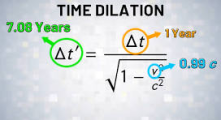
This is a first read for me...Hmm..reminds me of the Kecksburg Acorn looking thing. Maybe it did work and travelled at those speeds into the future. Time dilation???

1781991390041.png

My regards,

Bally!)
 

Yeah, I'm starting here from AI. (?) Will follow up.

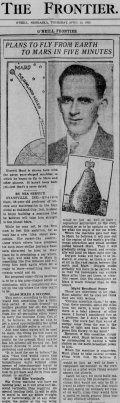
Everette Hunt was a 34-year-old math and science teacher from Oakland City, Indiana, who created a wildly ambitious, albeit scientifically impossible, blueprint in 1929 to send humans to Mars in under 10 minutes.
His plan was a product of unbridled imagination combined with a fundamental misunderstanding of physics:
  • The Spacecraft: Hunt drew detailed blueprints for a pear-shaped spacecraft designed to carry humans to the Red Planet.
  • The Propulsion: Rejecting traditional fossil fuels and engines, Hunt theorized that his ship would be powered solely by the atmosphere itself.
  • The Velocity: He believed this atmospheric engine would shoot the craft through the stars at 186,000 miles per second—the speed of light.
  • The Reality: While his design could get a crew to Mars in less than 10 minutes, the laws of physics made the concept impossible. The friction required for such thrust and the g-forces generated at the speed of light would have instantly destroyed the ship and its passengers.

Kind regards,

Bally)
 
Yeah, I'm starting here from AI. (?) Will follow up.

Everette Hunt was a 34-year-old math and science teacher from Oakland City, Indiana, who created a wildly ambitious, albeit scientifically impossible, blueprint in 1929 to send humans to Mars in under 10 minutes.
His plan was a product of unbridled imagination combined with a fundamental misunderstanding of physics:
  • The Spacecraft: Hunt drew detailed blueprints for a pear-shaped spacecraft designed to carry humans to the Red Planet.
  • The Propulsion: Rejecting traditional fossil fuels and engines, Hunt theorized that his ship would be powered solely by the atmosphere itself.
  • The Velocity: He believed this atmospheric engine would shoot the craft through the stars at 186,000 miles per second—the speed of light.
  • The Reality: While his design could get a crew to Mars in less than 10 minutes, the laws of physics made the concept impossible. The friction required for such thrust and the g-forces generated at the speed of light would have instantly destroyed the ship and its passengers.

Kind regards,

Bally)
Thanks Bally. I'll have to dig into this a little more when I wake up. I'm curious what happened to him after he publicly came out with this idea. I'm a history nerd, so this kind of thing is right up my alley.
 
Thanks Bally. I'll have to dig into this a little more when I wake up. I'm curious what happened to him after he publicly came out with this idea. I'm a history nerd, so this kind of thing is right up my alley.
Not getting much more even in obituaries. I'll keep trying but nothing cept ....nothing.

Bally

Edit - The specific contents of the newspaper clippings in Everett Hunt’s 1929 spaceship diary remain unpublished, though they likely featured 1920s media coverage of rocket pioneers like Robert Goddard or speculative physics articles. Discovered by Jim Linderman, the unverified notebook contains handwritten plans for space travel, including claims of traveling 35 million miles in five minutes.

Courier Press wants a subscription to look at the article. I fear it may be the same as initially posted.

Still looking.

The Concept and Design
  • The Shape: A unique, pear-shaped vessel designed to carry human passengers.
  • The Propellant: Zero petrol, oil, or traditional rocket fuel.
  • The Engine: Completely engine-free, relying entirely on the "atmosphere itself" to generate propulsion.
  • The Speed: He claimed it would shoot humans through space at 186,000 miles per second—the speed of light. [1]

The Reality Check
While Hunt's ambition predated the actual Space Age by decades, his blueprint completely ignored the fundamental laws of physics. At the speed of light, it would actually take roughly 3 minutes to reach Mars at its closest approach—meaning his 10-minute estimate was surprisingly close for that speed—but accelerating a physical object to light speed using only atmospheric pressure is a physical impossibility.
Despite the mathematical flaws of his machine, Hunt's visionary thinking remains a fascinating piece of early 20th-century sci-fi optimism and Indiana folklore.

Bally)
 
Last edited:
@GRIZZ0317

3 sites

  • Indiana science teacher formulated plan to send humans to ...
    19 July 2021 — Meet the Indiana science teacher who planned to send humans there in 1929. Jon Webb. Evansville Courier & Press. July 19, 2021Upda...
    Courier & Press


  • Everett Hunt's ship could deliver people to the surface of Mars in ...
    19 July 2021 — Everett Hunt's ship could deliver people to the surface of Mars in less than 10 minutes. The problem? Physics.
    www.facebook.com


  • Prelude to the space age : the rocket societies, 1924-1940
    Page 13. ForCWOrd. "Imagine, grown people really thinking that man could fly to the Moon!" Such was an almost. universal public re...
    Internet Archive
After presenting his Mars spaceship design, Everett Hunt essentially vanished into historical obscurity, leaving behind very little public record of his life or career. Because his designs were never taken seriously by the scientific or patent community, his spacefaring ambitions stopped abruptly in 1929. [1]
The specific details that trace the aftermath of his design include:
  • The Withheld Secret: Hunt never publicly revealed the exact mechanism of his "atmosphere-fueled" engine. He fiercely guarded the details, stating he would keep them "under his hat" until he could secure a legal patent.
  • The Denied Patent: Because his machine relied on physics-defying propulsion that ignored the laws of thermodynamics and relativity, he was never granted a patent. Without legal protection, he never built a prototype or revealed his blueprints to any manufacturers.
  • The Forgotten Diary: Hunt's ideas mostly survived through a single, physical artifact: a handwritten personal diary and scrapbook. Discovered decades later by an art collector and blogger named Jim Linderman, the diary contained news clippings, ship drawings, and the alternate title: "Going to Mars: 35,000,000 miles in 5 minutes, by Professor Everett Hunt".
  • Return to Teaching: Lacking the scientific backing or capital to pursue his light-speed vessel, Hunt is believed to have quietly continued his career as a local school teacher, away from the media spotlight.
 

Attachments

  • 1782020894779.png
    1782020894779.png
    452 bytes · Views: 0
  • 1782020894798.png
    1782020894798.png
    579 bytes · Views: 0
  • 1782020894802.png
    1782020894802.png
    294 bytes · Views: 0
  • 1782020894812.png
    1782020894812.png
    280 bytes · Views: 0
  • 1782020894793.png
    1782020894793.png
    12.4 KB · Views: 0
Back
Top Bottom