

Freija
Forum Wench
- Joined
- May 20, 2026
- Messages
- 123
- Reaction score
- 206

Hantavirus May Have Been Spreading in the Pacific Northwest for Over 100 Years
New research finds hantavirus has circulated in Pacific Northwest rodents for possibly 100+ years, and deer mice may not be the only animals spreading it.
 studyfinds.com
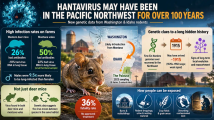
A virus with a 36% fatality rate appears to have been quietly circulating across Pacific Northwest farms for more than a century — and scientists are only now uncovering the genetic evidence of how long it has been there.
New research published in Emerging Infectious Diseases offers the first genomic sequences of Sin Nombre virus ever recovered from the northwestern United States. Drawn from rodent trapping across farms and natural areas in Washington and Idaho, the analysis suggests the virus may have arrived in the region from Montana sometime around 1915, though scientists are careful to note the uncertainty in that estimate is wide. What’s harder to dispute is what the data show about the present: the pathogen is circulating at high rates, actively infecting multiple rodent species, and has been diversifying locally for what could be generations without meaningful genomic tracking.
Sin Nombre virus is the primary cause of hantavirus pulmonary syndrome in North America, a severe respiratory illness with no approved treatment. People contract it by inhaling microscopic particles shed in infected rodent droppings, urine, or nesting material — a straightforward exposure risk in barns, outbuildings, or crop fields.
Genomic Evidence Points to a Century of Undetected Hantavirus Spread
Recovering actual genome sequences from the Palouse rodents was itself a significant step. Fewer than 100 complete Sin Nombre genomes had ever been published globally before this work, and not one had come from the northwestern United States. The team recovered full or near-complete sequences from 10 rodents, including two montane voles, marking the first such data from the region.
When those sequences were compared against the broader national library of Sin Nombre genomes, the Palouse samples formed a distinct genetic cluster most closely related to strains collected in Montana between 2008 and 2009. Phylogeographic modeling, a technique that uses genetic data to reconstruct where and when a virus moved across geography, pointed to an introduction into Washington from Montana that could date to approximately 1915. The confidence interval on that estimate spans from the 1870s to 1982, and the researchers explicitly flag the temporal signal as weak. The implied history is plausible based on the data, not definitively established.
Most of the reported cases of the Hantavirus have been in the Southwest. With these findings it is surprising that more have not been seen in the PNW.