
Freija
Forum Wench
- Joined
- May 20, 2026
- Messages
- 430
- Reaction score
- 837
Scientists have just unlocked the secrets of an ancient scroll torched by Mount Vesuvius
After a centuries-long struggle, scholars managed to read five feet of text, using machine-learning methods they hope can unlock further discoveries.
For centuries, ancient scrolls torched nearly 2,000 years ago in the eruption of Mount Vesuvius have remained a mystery.
Once buried in hot rocks, ash and lava, the scrolls are so fragile and carbonized that they fall apart at the touch. Since their discovery in 1752, various attempts to read them — splitting them open and scraping away each slice of ancient paper with a knife, pouring mercury between the layers, soaking them in a mix of gelatin and acetic acid — have destroyed them or rendered them illegible.
Now, researchers say they have managed to completely unwrap and read the surviving portion of one scroll, about 20 columns of text, using machine learning methods that they hope can unlock further discoveries from a lost classical library.
The scrolls belong to a collection of more than 400 papyri recovered from a villa in the ancient seaside town of Herculaneum, believed to have belonged to the father-in-law of Julius Caesar. The algorithms developed by researchers at the University of Kentucky and the Vesuvius Challenge (a Silicon Valley-backed open competition), coupled with advanced imaging from a particle accelerator, have slowly unveiled various portions of the scrolls that can be analyzed by papyrologists. First, a single word in 2023, then a few phrases, and now — in the latest leap announced Thursday — at least 230 columns of text across several scrolls.
In addition to academics, the scrolls have been the focus of the Vesuvius Challenge, an open call launched by the Silicon Valley investors Nat Friedman and Daniel Gross, in collaboration with Seales. In 2023, the challenge awarded its $700,000 grand prize to a group of students who read more than 2,000 characters off of 11 scroll columns.
Since then, the Vesuvius Challenge has continued to support research efforts on the scrolls, including funding the cutting-edge scanning required to tease apart the charred papyrus layers.
“It’s a feature that is particularly hard to image because of the fact that it’s carbonized,” said Giorgio Angelotti, the challenge’s research lead.
In addition to academics, the scrolls have been the focus of the Vesuvius Challenge, an open call launched by the Silicon Valley investors Nat Friedman and Daniel Gross, in collaboration with Seales. In 2023, the challenge awarded its $700,000 grand prize to a group of students who read more than 2,000 characters off of 11 scroll columns.
Since then, the Vesuvius Challenge has continued to support research efforts on the scrolls, including funding the cutting-edge scanning required to tease apart the charred papyrus layers.
“It’s a feature that is particularly hard to image because of the fact that it’s carbonized,” said Giorgio Angelotti, the challenge’s research lead.
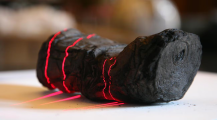
“The diameter and in general the structure of the wrapping-up is pretty regular,” said Federica Nicolardi, who led a team of papyrologists for the challenge. “It’s kind of cute, I have to say, because it’s really, really tiny and very thin also,” she added. PHerc. 1667 is about 2 centimeters wide and 8 centimeters tall and is only a piece of a once-completed scroll.
“What is difficult, especially when you’re working with fragmentary material, is the fact that papyri are written in majuscule letters, with no spacing between words,” Nicolardi said. “Most of the time you don’t have punctuation or you just have very limited punctuation marks. So you need to read, understand the syntax and interpret.”
The rest of the story can be read at the link above.